
Welcome to Clearly Hormonal
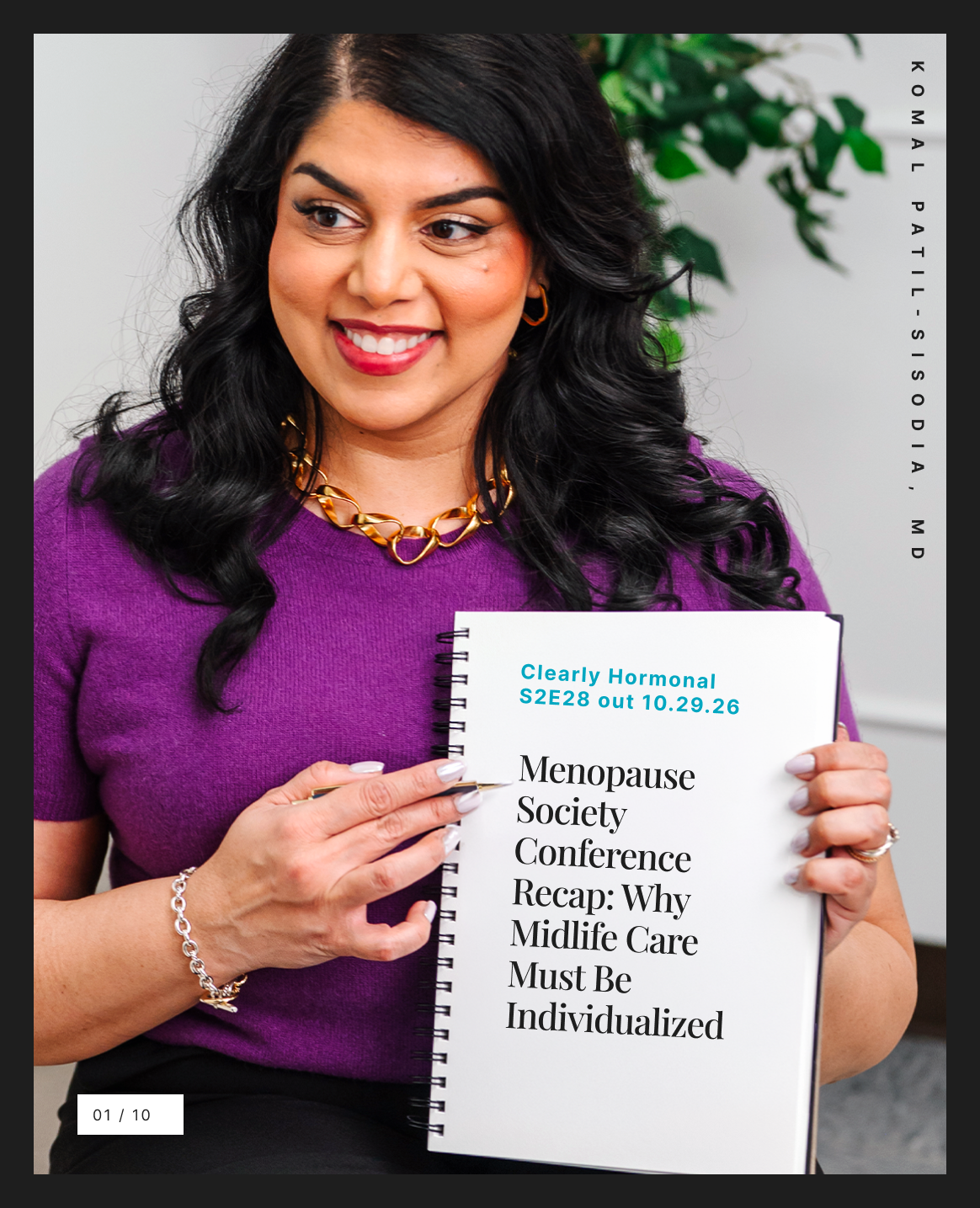
I just got back from the Menopause Society annual meeting in San Diego, and in this episode I share what I am bringing back to my clinic and my patients. Women's health is having a moment, and with that attention has come a lot of polarization. My take as an endocrinologist is simple: there is no one-size-fits-all menopause, and good care combines the data we have with clinical nuance, your symptoms, and your goals.
We walk through the biggest themes from the meeting: how body composition and bone change during the transition, where exercise and hormone therapy fit, what the FDA label changes do and do not mean, nonhormonal options for hot flashes, sleep and mood, heart health screening, sexual health, hair loss, supplements, and why bleeding after menopause always needs evaluation. You will leave with clear questions to bring to your next visit.
What I Brought Home from the Menopause Society Meeting: Why Midlife Care Must Be Individualized
By Dr. Komal Patil-Sisodia, MD | Eastside Menopause & Metabolism
I just got back from the Menopause Society annual meeting in San Diego, and I needed a few days to sort through everything I heard before I shared it with you. Some of it was exciting. Some of it I disagreed with. All of it reinforced something I see in my clinic every week: there is no one-size-fits-all menopause.
Women's health is having a moment, and it has been for the past five or six years. That attention is long overdue. It has also brought a lot of polarization about what the next best step is for women. After the meeting, my social feeds were full of strong opinions. Some people felt there was not enough clinical nuance. Others felt there was not enough science. Some felt the stage was given to people pushing controversial ideas.
Here is where I land. There was good science at this meeting. And we still need clinical nuance in every conversation about midlife health. My menopause will not look like your menopause, and neither of ours will look like the menopause of the woman walking down the street. Good care starts with your symptoms and your goals, then applies the evidence to you.
One more note before we dig in. A talk at a medical meeting can include new research, established guidelines, and a speaker's personal opinions about how care should be delivered. Those are different kinds of information, and I will keep them separate as we go.
Your body can change even when the scale does not
One of the most common things I hear is, "My body feels different, and I don't understand why." Maybe your clothes fit differently even though your weight has barely changed. Maybe the scale has gone up and you are wondering what happened.
A talk at the meeting reviewed SWAN, the Study of Women's Health Across the Nation, which has followed women through midlife for years. Researchers found that body fat can increase while lean tissue, like muscle, decreases. Where we store fat shifts too, and these changes can be bigger than what shows up on the scale. These are patterns across groups of women, and they can differ by racial and ethnic background. They do not tell us exactly what is happening in your body.
That is why I want to know more than your weight. Can you climb stairs comfortably? Carry what you need to carry? Get up from a chair easily? If weight loss is part of your plan, I want that plan to protect muscle and bone too, with nutrition and strength discussed from the start.
The bone loss window starts earlier than most women realize
In the SWAN data, the fastest bone loss happened from about one year before the final menstrual period to two years after it. Both lower bone density and faster bone loss were linked to fractures later in life.
As an endocrinologist, this one hits home. Routine bone density screening generally starts at 65 for women without added risk factors. I see women who reach their final period in their 40s, and when I screen them proactively, many already have osteopenia or osteoporosis. That can be twenty years of bone loss with no one talking about it. We can start that conversation much earlier.
To be clear, one speaker proposed a bone scan for every woman during perimenopause. That is not an established screening recommendation, and I had concerns about it. Every test should have a clear reason, based on your history and risk.
Exercise that meets you where you are
Strength training builds strength, aerobic exercise supports fitness, and balance work and safe bone loading all have a role. The right program depends on your current ability, your health conditions, and your fracture risk. If you have never worked out, I am not sending you to CrossFit. We might start with walking and strength training a few times a week, then build from there. If sleep or pain are getting in the way, we address those too.
Hormone therapy: what the label changes mean and do not mean
The FDA presentation reviewed recent changes to menopause hormone therapy labels. Some language about heart disease, breast cancer, and dementia was removed from the boxed warning, which is the most prominent warning a drug label can carry. Information about heart disease and breast cancer risk still appears elsewhere on the label.
A change in warning language does not mean the risks disappeared. It should help us have clearer conversations about risks and benefits. It should not become a blanket statement that hormones are safe for everyone.
Hormone therapy can be a very useful option for symptoms like hot flashes, and it can help protect bone in appropriate patients. It is not a main treatment for weight loss, and relieving symptoms does not mean it prevents heart disease or dementia. The decision depends on your age, your health history, your symptoms, and how long it has been since menopause. Early loss of ovarian function and a history of breast cancer both change the conversation.
It also matters which treatment we are talking about. Systemic hormone therapy, which acts throughout the body, is different from low-dose vaginal estrogen used for local symptoms like dryness. The doses, uses, and risks are not identical. And if hormones are not a fit for you, or you prefer not to take them, there are nonhormonal options for hot flashes, including newer medications that act on the brain's temperature regulation. Those have their own risks and may require liver monitoring.
Sleep, mood, and brain fog deserve a real evaluation
If hot flashes are waking you up, treating them may help. But not every sleep problem is menopause. If you still cannot sleep after hot flashes improve, take another look with your clinician. Sleep apnea is common in women and often goes undiagnosed. It can show up as fatigue, morning headaches, trouble concentrating, and snoring, which overlap with menopause symptoms. For ongoing insomnia, cognitive behavioral therapy for insomnia (CBT-I) teaches skills that retrain sleep.
Most women do not develop major depression during menopause, but some are more vulnerable during this transition. Depression deserves assessment and treatment, not a shrug. And while helping brain fog matters, clearing it up does not mean a treatment prevents dementia.
Feeling better and protecting your health go together
Some changes are easy to notice. Others, like high blood pressure or high cholesterol, cause no symptoms at all. A visit for hot flashes is a chance to review blood pressure, blood sugar, and cholesterol over time. Your pregnancy history matters too: diabetes or high blood pressure during pregnancy, and early menopause, can signal higher cardiovascular risk later. You do not need every test mentioned at a conference, but a useful test should answer a question that could change your care.
The concerns women often leave out
Sexual health, pelvic pain, hair loss, and skin changes all came up at the meeting, and they are hard to talk about in an exam room. If sex hurts, say so. Dryness may be part of it, but tight pelvic floor muscles or a skin condition can also play a role. Changes in desire can involve pain, mood, medications, relationships, and stress, and a testosterone blood test alone does not diagnose a desire disorder. Testosterone can help some women after menopause who have a diagnosed desire disorder. For energy, mood, or memory, the evidence is not there yet.
Hair loss has many causes, including scarring scalp conditions, nutrient deficiencies, thyroid issues, and genetic female pattern hair loss. Hormone therapy will not fix all of them. Bring your supplement list too. Some supplements treat a real deficiency, but a product marketed for "hormone balance" still needs evidence that it works, and supplements are not held to the same standard as FDA-approved drugs.
One symptom you should always report: bleeding after menopause. It needs evaluation, often with a pelvic ultrasound, an endometrial biopsy, or both. If it continues or comes back after a reassuring test, it needs another look.
A plan has to fit your life
One of the most useful themes at the meeting was the support women need to make care possible. Caring for a parent, working long hours, or worrying about cost all shape what is realistic. I ask my patients what is going on in their lives and listen without judgment so we can choose realistic goals. The same goes for alcohol, cannabis, or anything else you are using to cope. Knowing what you use and what you hope it does helps us build a better plan.
What I am bringing home
The biggest lesson is the value of taking the whole story seriously. When you say, "I don't feel like myself," you deserve room to explain what that means. You do not need to sort your concerns into medical specialties before asking for help.
Before your next visit, think about what has changed, what is affecting you most, and what you want help with first. Bring your medication list, your supplement list, your history, and all of your concerns.
Follow Dr. Komal Patil-Sisodia:@drpatilsisodia on Instagram and TikTok
This content is for educational purposes only and does not constitute personalized medical advice. Please discuss your specific health concerns with your own healthcare provider.