

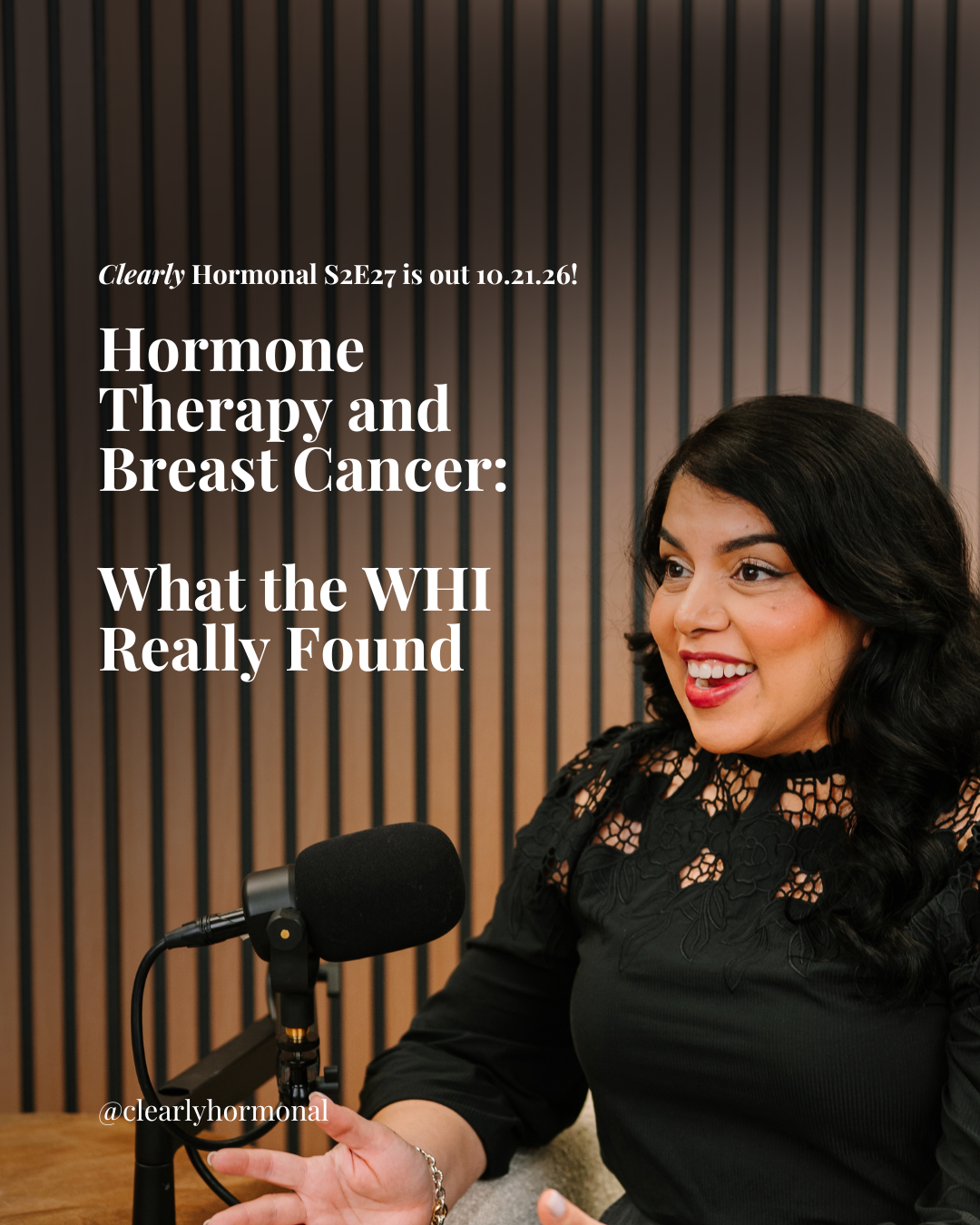
S2E27: Hormone Therapy and Breast Cancer: What the WHI Really Found
Welcome to Clearly Hormonal
Your weight has not changed, but your body has. In this episode, Dr. Komal Patil-Sisodia explains why body composition shifts during the menopause transition, why the scale cannot tell the whole story, and what you can do about it. She shares her own experience after a hysterectomy, breaks down the difference between subcutaneous and visceral fat, explains insulin resistance with a classic TV analogy, and walks through a realistic foundation of strength, nutrition, sleep, and sustainable planning. She also covers where menopause hormone therapy and obesity medications fit, and why higher body fat after menopause is linked to breast cancer risk without placing blame on anyone.
Why Your Body Composition Changes in Midlife (Even If the Scale Doesn't)
By Dr. Komal Patil-Sisodia, MD | Eastside Menopause & Metabolism
If you are a woman in midlife, there is a good chance one sentence has shaped how you think about hormone therapy: hormones can cause breast cancer. Maybe a friend said it over coffee. Maybe a doctor mentioned it years ago. Maybe it is just one of those health rules we pick up and never really check.
I have heard that sentence in my office more times than I can count, and I have seen how heavy it feels. A woman can be up all night with night sweats, exhaustion, and brain fog, and still say, "I just can't risk it." This October, which is both Menopause Awareness Month and Breast Cancer Awareness Month, I want to take that sentence apart gently and honestly. I am not here to tell you to take hormones, and I am not here to tell you to avoid them. I want fear to stop being the only thing guiding the decision.
Start with the better question
Hormone therapy and breast cancer is not a yes or no question. It is a question of which hormone, for whom, for how long, and compared to what. Asked that way, the fear gets smaller and the real risks get clearer.
Who the WHI actually studied
Almost everything people say about hormone therapy and breast cancer traces back to the Women's Health Initiative. It was large and well run, and in 2002 the combined hormone therapy portion was stopped early. Headlines were loud and prescriptions dropped fast.
Here is what often gets lost. The average woman in the WHI was 63, and about two in three were 60 or older when they started. Most women who start hormone therapy for symptoms today are in their late forties or early fifties. The study used oral conjugated equine estrogen, paired with a synthetic progestin called MPA in the combined trial. And it was built to test whether hormones could prevent diseases like heart disease, cancer, and fractures in older women, not to test symptom relief in women who were newly menopausal.
Two trials, two answers
The WHI was actually two trials. Women with a uterus took estrogen plus a synthetic progestin or placebo. Women who had a hysterectomy took estrogen alone or placebo. In the 20-year follow-up published in JAMA in 2020, the combined group had about a 28 percent higher rate of breast cancer than placebo. The estrogen-alone group had about 22 percent less breast cancer and about 40 percent fewer breast cancer deaths.
I want to be clear that this does not mean estrogen prevents breast cancer. That result runs against most of the other research we have, and I would never prescribe hormones to lower breast cancer risk. On deaths in the combined group, the picture shifted over time. At about 11 years there were more breast cancer deaths, but over longer follow-up the gap shrank and was no longer statistically significant. The long-term data did not show a clear difference, but the question is not completely closed.
What the WHI could not answer
The WHI did not test micronized progesterone, the bioidentical progesterone most of us use today, and it did not test estrogen through the skin. Some observational studies suggest micronized progesterone may carry a lower breast cancer risk than synthetic progestins, but those are not randomized trials. I call that promising, not proven, and major guidelines say the evidence is not yet strong enough to pick one progestogen over another to lower breast cancer risk.
What changed at the FDA
In November 2025, the FDA announced it would remove the boxed warning on menopause hormone therapy, and in February 2026 it approved the first label changes for six products, with others following in batches. The old box mentioned heart disease, stroke, breast cancer, and probable dementia. That language is out of the box, but safety information remains in the prescribing information. The boxed warning about cancer of the uterine lining stays, so if you have a uterus and take estrogen, you need a progestogen. And breast cancer is still listed as a reason not to use systemic hormone therapy if you have a current or past diagnosis.
Absolute risk: the numbers behind the percentage
A 28 percent increase sounds enormous, but it is a relative number. In the WHI, women on placebo had about 3.6 breast cancers per 1,000 women per year. Women on combined therapy had about 4.5. That is less than one extra case per 1,000 women per year, or about five extra cases per 1,000 women over the trial. It is real and it is not nothing, but it is not the picture the sentence "hormones cause breast cancer" puts in your mind.
Now put it beside risks we rarely question. Regular alcohol use, carrying extra body fat after menopause, and inactivity all raise breast cancer risk, and for many women those everyday factors add up to as much as or more than the added risk from combined therapy. I am not saying that to shame anyone. I am saying we often hold hormone therapy to a stricter standard than the habits we already live with. For context, about one in eight women in the United States will be diagnosed with breast cancer in her lifetime, whether or not she ever took a hormone.
Four myths worth retiring
Myth 1: Hormones cause breast cancer. The evidence is more nuanced. In the WHI, combined estrogen and a synthetic progestin was linked to a modest rise in diagnosis, and estrogen alone in women with a hysterectomy was not. Type, timing, and your own risk all matter.
Myth 2: Bioidentical means safe. Bioidentical only means the molecule matches what your body makes. FDA-approved estradiol patches and micronized progesterone are bioidentical and tested. Compounded pellets and custom creams are not FDA approved, and their doses can vary without safety data behind them. Natural does not automatically mean safer.
Myth 3: Estrogen alone prevents breast cancer. It is not a reason to start therapy, and it does not apply to women who need a progestogen.
Myth 4: If I take hormones, I can skip my mammogram. It is the opposite. Combined therapy can increase breast density and the chance of a callback, which is a reason to stay on your screening schedule.
Breast health and metabolic health are the same track
After menopause the ovaries make much less estrogen, but body fat becomes a source of estrogen by converting other hormones. More body fat can mean more estrogen exposure in the breast, which is one reason excess weight after menopause is linked to higher breast cancer risk. Menopause also shifts fat toward the belly, lowers muscle, and makes insulin resistance more likely. That is biology, not a willpower problem.
Some of the best things you can do for breast cancer risk are within your control: strength training to build and protect muscle, moving most days, limiting alcohol, protecting sleep, and not smoking. Hormone therapy is not a weight loss treatment, but by easing night sweats, poor sleep, and low energy it can make healthy habits easier to keep.
Screening, density, and risk assessment
The US Preventive Services Task Force recommends a mammogram every two years for women ages 40 to 74, and some groups recommend yearly screening. The right schedule depends on your own and your family's history. Since September 2024, the FDA has required mammogram reports to tell you whether your breasts are dense. Dense breasts are common, can hide cancers on a mammogram, and are linked to higher risk on their own. The task force says there is not enough evidence yet to know whether extra imaging helps women with dense breasts and a normal mammogram, while other expert groups support it in certain cases. If your report says dense, do not panic and do not ignore it. Ask, "Given my density, my family history, and my overall risk, what is the right plan for me?" Ask, too, whether a breast cancer risk model makes sense for you, especially with a close relative who had breast or ovarian cancer.
If you have a breast cancer history or high risk
For most women with a personal history of breast cancer, systemic hormone therapy is not recommended, but you are not out of options. For hot flashes and night sweats there are nonhormonal choices, including venlafaxine, gabapentin, newer prescription medications that target the brain pathway behind hot flashes, cognitive behavioral therapy, and clinical hypnosis. If you take tamoxifen, paroxetine and fluoxetine can interfere with how the body activates it, and most guidelines advise avoiding them, with venlafaxine a safer choice. Always check new medications with your oncology team. For vaginal dryness and painful sex, start with hormone-free moisturizers and lubricants; some women may be offered very low-dose vaginal estrogen after a careful conversation with their oncologist. If you carry a high-risk gene or have a strong family history, plan with a breast cancer and menopause specialist working together.
The three things to remember
"Hormones cause breast cancer" is too simple. Type, age, uterus status, and personal risk change the answer.
Look at absolute risk, not only the percentage, and weigh it beside alcohol, body fat, and inactivity.
Whatever you choose, keep up with screening, know your density, and build muscle.
You deserve to make this decision with facts, not fear.
Call to action
Listen to Episode 3 of Clearly Hormonal wherever you get your podcasts, and come back next Wednesday for the Episode 4 finale on cardiometabolic health at menopause.
If PMOS is part of your story, my course The PMOS Conversation You Deserve is live now with six modules, a practical workbook, and monthly live Q&A calls.
Learn more: The PMOS Conversation You Deserve
Follow Dr. Komal Patil-Sisodia:@drpatilsisodia on Instagram and TikTok
This content is for educational purposes only and does not constitute personalized medical advice. Please discuss your specific health concerns with your own healthcare provider.