

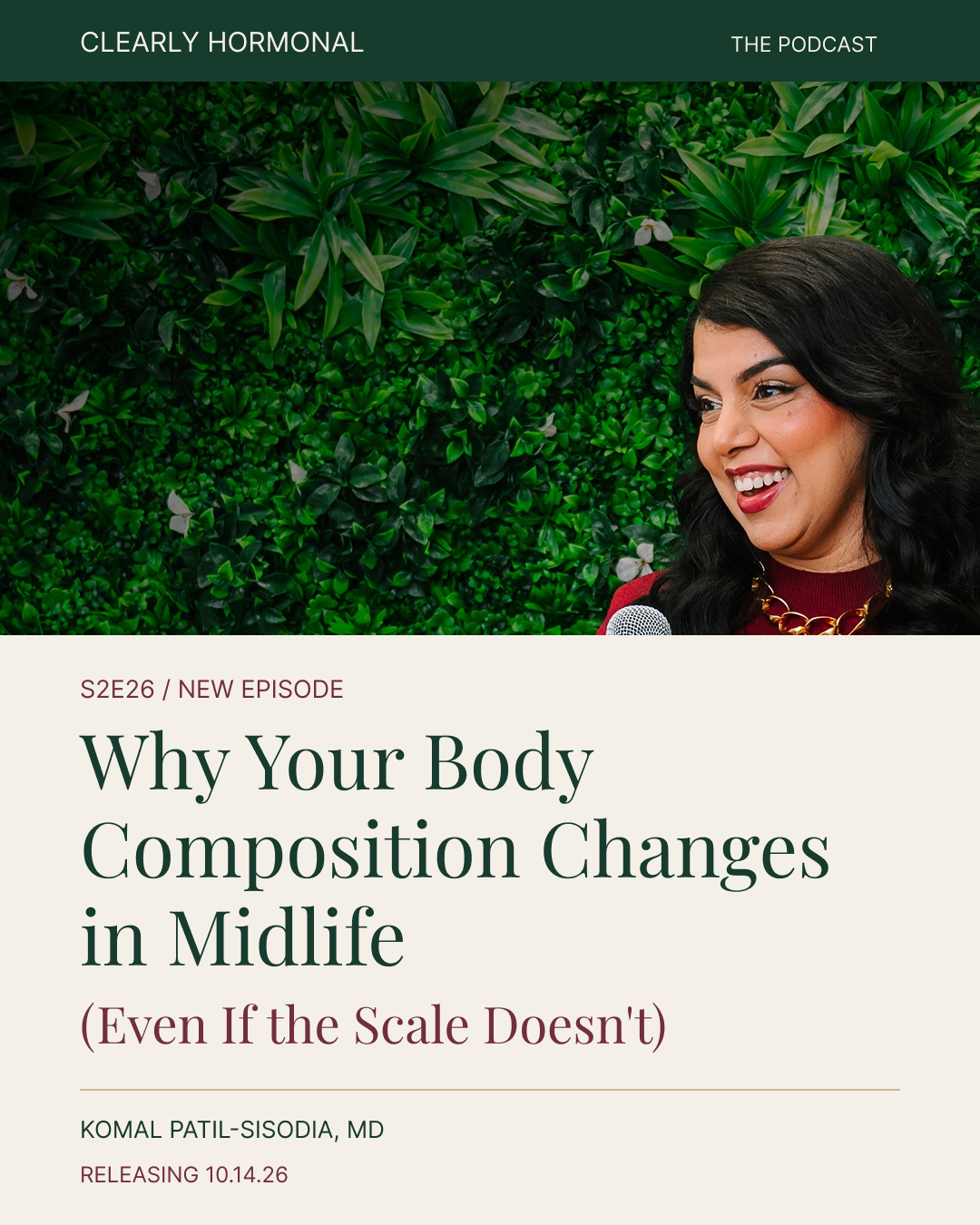
S2E26: Why Your Body Composition Changes in Midlife (Even If the Scale Doesn't)
Welcome to Clearly Hormonal
Your weight has not changed, but your body has. In this episode, Dr. Komal Patil-Sisodia explains why body composition shifts during the menopause transition, why the scale cannot tell the whole story, and what you can do about it. She shares her own experience after a hysterectomy, breaks down the difference between subcutaneous and visceral fat, explains insulin resistance with a classic TV analogy, and walks through a realistic foundation of strength, nutrition, sleep, and sustainable planning. She also covers where menopause hormone therapy and obesity medications fit, and why higher body fat after menopause is linked to breast cancer risk without placing blame on anyone.
Why Your Body Composition Changes in Midlife (Even If the Scale Doesn't)
By Dr. Komal Patil-Sisodia, MD | Eastside Menopause & Metabolism
The number on the scale looks the same as it did last year. But your clothes fit differently, your waist feels thicker, and your strength is not what it used to be, even though you are working just as hard. If that sounds familiar, you are not imagining it, and you are not doing anything wrong.
This is one of the most common concerns I hear in my office, and it happened to me too. After my hysterectomy in October 2024, I watched my muscle mass go down despite all the prehabbing I had done and the workouts I kept up. I stepped on the scale, saw the same weight, and thought, my body looks different. I assumed it was surgical recovery, but three months out, things had not gone back to the way they were. I had the same questions my patients ask. Is this menopause? Is this aging? Is this poor sleep? And what can I do about it?
The scale only tells part of the story
Your total weight is the combined weight of your muscle, fat, bones, organs, and water. Body composition is the share each of those contributes. Three ideas are worth remembering.
You can gain fat and lose lean tissue without a large change on the scale.
Lean tissue is more than muscle. It also includes organs, water, and connective tissue, so a drop in lean mass does not automatically mean you are losing muscle.
Where your body stores fat can change even when your weight stays similar.
In the SWAN study, which followed women through the menopause transition, fat mass increased and lean mass declined, while weight gain did not speed up in the same way. In other words, what many women notice is not necessarily weight gain. It is a change in body composition.
Hormones matter, but they are not the whole picture
As estrogen and progesterone decline during the menopause transition, fat storage tends to shift toward the abdomen. These changes can begin before your periods stop, which is part of what makes this so confusing. You feel it happening, while being told to eat more protein, more fiber, drink more water, and move more. Those habits can help. But if you are already doing them and your body is still changing, your hormones may be changing too, and you may need a different conversation.
Hormones are one bucket, not the only one. Aging changes your muscles and your energy needs. Joint pain, injuries, a demanding job, or caregiving can make baseline movement much harder. Night sweats and disrupted sleep affect your energy, your appetite, and whether you make it to your workout. Stress, certain medications, and conditions like hypothyroidism, prediabetes, and insulin resistance can all contribute. We usually cannot point to a single cause. Everything contributes in little chunks, so we have to work on several things at once.
Why visceral fat and muscle matter
There are two main types of abdominal fat. Subcutaneous fat sits under the skin, the fat you can pinch. Visceral fat sits deeper, around your internal organs, and it is more metabolically concerning, with higher risks of diabetes and cardiovascular disease. One simple clue is your waist measurement. If your weight is steady but your waist is growing, that may suggest more visceral fat. It is not a perfect method, because you can also gain fat under the skin in that area, but it is a useful trend to track.
Muscle matters just as much. It supports walking, lifting, balance, and independence, and it helps your body use up sugar from your bloodstream. With less muscle, there is less place for that glucose to go.
Insulin resistance, explained
Insulin moves sugar from your bloodstream into your cells. With insulin resistance, your cells do not respond to that signal as well, so your pancreas has to make more insulin. I like to compare it to the chocolate factory episode of I Love Lucy, where the conveyor belt keeps speeding up and Lucy and Ethel cannot wrap the chocolates fast enough. Your pancreas may keep up for years, but if it cannot meet the demand, blood sugar rises.
Insulin resistance is not inevitable for everyone. Genetics and lifestyle both play a role, and people with existing metabolic conditions such as PMOS (formerly PCOS), prediabetes, type 2 diabetes, or overweight or obesity are at higher risk. That is why it helps to watch the bigger picture: your strength, your sleep, your blood pressure, cholesterol, and blood sugar, and your waist size alongside your weight.
What can actually help
Strength and movement
I recommend strength training at least twice a week to maintain the muscle you have. It does not need to be heavy. Resistance bands, body weight squats, squatting to a chair, wall pushups, and lighter free weights all count. Start where you are, because lifting too heavy after a long break is a common way people get hurt. Work toward 150 minutes of moderate activity each week, and over time up to 300 minutes, with activities like brisk walking, swimming, or cycling. If pain or an injury is getting in the way, talk to your doctor and consider physical therapy.
Nutrition
Include a protein source at meals, such as eggs, yogurt, tofu, beans, fish, or meat, along with plenty of fiber from vegetables, fruits, beans, and whole grains. Fiber helps slow the absorption of starches, which can help lower blood sugar. Your protein needs are personal, so rather than chasing a number you saw online, work with your clinician or a registered dietitian to find your range. I am not a fan of heavy restriction. Everything can fit into a meal plan as long as the amount supports your health goals.
Sleep
Night sweats, insomnia, and late-night screens can all get in the way, and sleep apnea becomes more common as hormones decline. If sleep is a concern, ask your doctor about a sleep study.
Barriers and sustainability
Look honestly at what keeps you from regular meals, movement, and rest, and build a plan that fits your actual life. I have made plenty of plans over the years, and the lesson is always the same: a plan only works if you can keep doing it.
Where hormone therapy and obesity medications fit
Menopause hormone therapy is not a weight loss treatment, and it is not prescribed for that purpose. That said, some studies suggest it may lessen the shift toward visceral fat. In a smaller study within the Women's Health Initiative, women taking estrogen and a progestin lost less lean tissue and had a smaller change in body composition over three years. The differences were small, and these findings do not guarantee weight loss, a reversal of abdominal fat, or preserved muscle. The decision to use hormone therapy should rest on your symptoms, your medical history, and your personal benefits and risks.
Obesity medications may be appropriate for some people, depending on BMI and other conditions such as high blood pressure, high cholesterol, prediabetes, diabetes, PCOS, sleep apnea, or a history of heart disease or stroke. Menopause alone does not mean you need one, but if you meet those other parameters and want to lose weight, it may be a good option. Treatment should reflect your health, your goals, and what you can sustain, with close follow-up if you go this route.
The breast health connection
October is both Menopause Awareness Month and Breast Cancer Awareness Month. After menopause, higher body fat is associated with a greater risk of breast cancer, potentially through estrogen production in fat tissue and inflammation tied to insulin resistance. But body fat is not the only explanation for why someone develops breast cancer, and risk factors should never be used to blame a person for a diagnosis.
What to bring to your next appointment
Before your visit, write down what has changed: how your clothes fit, your strength, your sleep, and how you feel during everyday activities. Then ask two questions. What might be contributing to these changes? What plan makes sense for me?
Key takeaways
Your body composition can change even when your weight does not.
Hormones, aging, sleep, less physical activity, and other factors can all contribute.
Your care plan should support your strength and metabolic health alongside your symptoms and goals.
If PMOS is part of your story, my course The PMOS Conversation You Deserve is live now with six modules, a practical workbook, and monthly live Q&A calls.
Learn more: The PMOS Conversation You Deserve
Follow Dr. Komal Patil-Sisodia:@drpatilsisodia on Instagram and TikTok
This content is for educational purposes only and does not constitute personalized medical advice. Please discuss your specific health concerns with your own healthcare provider.