

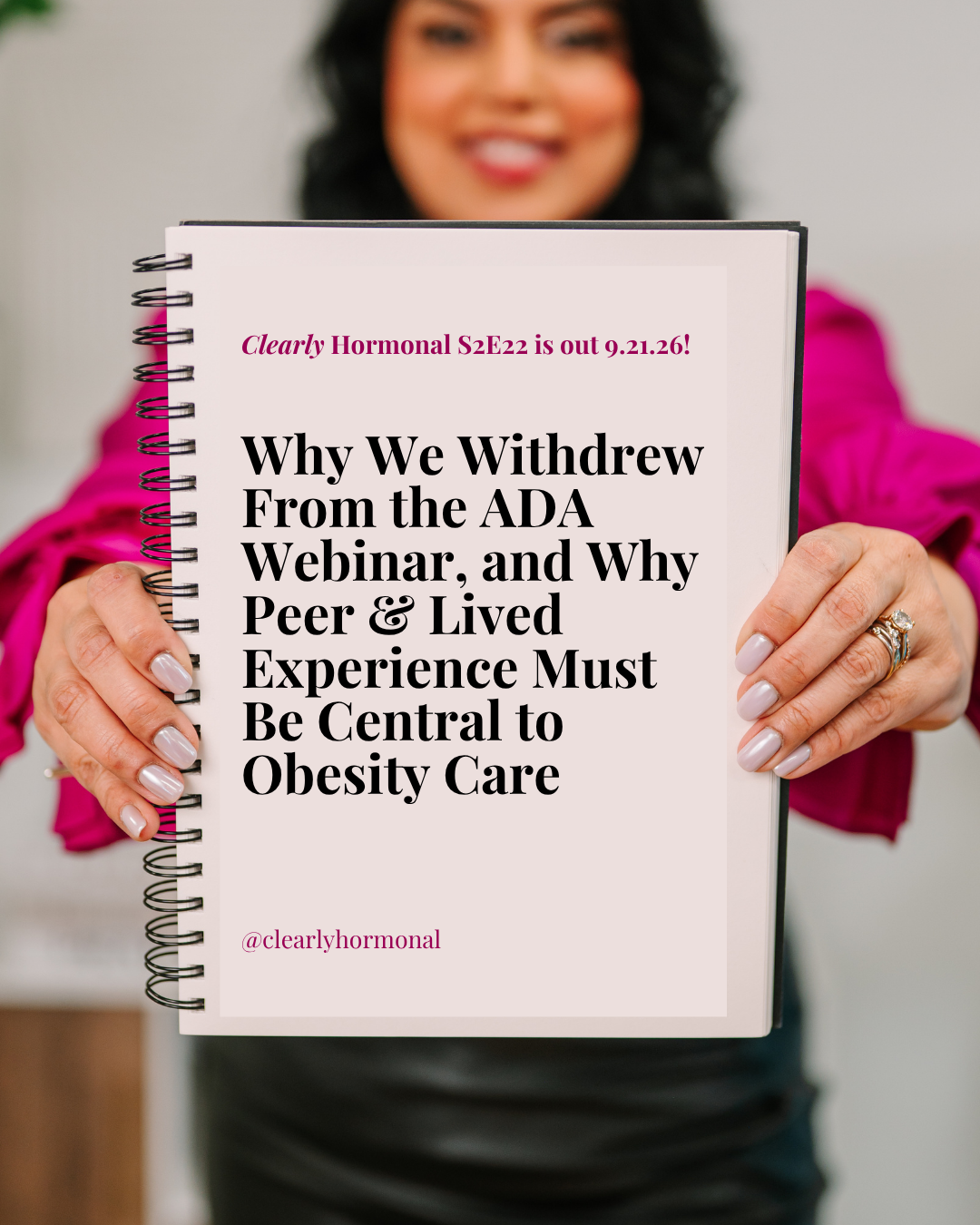
S2E22: Why We Withdrew From the ADA Webinar, and Why Peer & Lived Experience Must Be Central to Obesity Care
Welcome to Clearly Hormonal
Dr. Komal Patil-Sisodia, obesity advocate Michael Donnelly-Boylen, and Dr. Matthea Rentea explain why they withdrew from a planned ADA-hosted webinar in support of a broader boycott, after an ADA Scientific Sessions keynote by a MAHA representative and the removal of peacefully protesting scientists were followed by an organizational response the three of them found unsatisfying.
They still share the content they had planned to present: integrating peer and lived experience into obesity care, to address a trust gap driven by weight stigma, shaming language, and oversimplified messaging that can delay or derail care, including preventive screening and procedures. They talk through curiosity, person-first language, motivational interviewing, and acknowledging medical trauma, along with practical solutions such as moderated peer support groups, credible online resources, and comprehensive programs that combine lifestyle foundations, medications, bariatric pathways, and clinic infrastructure shaped by patient input.
Why We Withdrew From the ADA Webinar, and Why Peer & Lived Experience Must Be Central to Obesity Care
By Dr. Komal Patil-Sisodia, MD | Eastside Menopause & Metabolism
This episode was supposed to be a live webinar. Instead, it is a conversation about why that webinar never happened.
On September 16th, Dr. Matthea Rentea and Dr. Komal Patil-Sisodia were scheduled to present a session on integrating peer and lived experience into obesity care, moderated by Michael Donnelly-Boylen and hosted by the Obesity Association, a division of the American Diabetes Association. A few days before the event, the three of them withdrew in support of a broader boycott of ADA programming.
The decision traces back to the ADA's Scientific Sessions in New Orleans this past June, where a MAHA representative was given a keynote slot. Dr. Patil-Sisodia was in the room. The talk framed alignment between the MAHA agenda and the ADA's goals, then moved into territory unrelated to diabetes care, including vaccines and water fluoridation, along with suggestions that current research was falling short in ways a new administration and its priorities could correct. Scientists and physicians who peacefully protested, handing out a critical op-ed in the conference lobby, were removed from the conference by security.
The ADA commissioned an independent review afterward. Leadership acknowledged that parts of the situation could have been handled better, but the public response focused on narrow procedural questions rather than the larger one: how a scientific organization treats dissent from its own members. For a session about building trust and centering lived experience, presenting under that banner felt inconsistent with the values the panel would be asking clinicians to bring to their own patients.
So instead of stepping back from the material entirely, the three of them recorded this conversation, releasing it simultaneously across Clearly Hormonal, The Obesity Guide, and Weight and Measure. They walk through the keynote fallout and the reasoning behind the boycott, then deliver the substance of the webinar itself.
The trust gap in obesity care
Weight stigma in clinical encounters drives patients away from care. Patients report feeling dismissed, blamed, and reduced to oversimplified advice to eat less and move more, and traditional patient education has not closed that gap. The panel discusses how that stigma shows up concretely: delayed cancer screenings, colonoscopies postponed for lack of an appropriately sized bed, joint replacement candidates told to simply lose weight without any resources to do so.
Shared language matters as much as shared facts. Patient narratives and the words peers use with each other reduce shame in a way that clinical language alone cannot, and clinicians do not need to have lived a condition themselves to become good advocates for it. What they need is curiosity: a willingness to ask questions, sit with the answers, and use person-first language rather than assumptions.
What clinicians can actually do
The panel is candid that no clinician or system can fix everything at once. But every clinician has agency over how they take a history, how they ask consent to discuss weight, and whether they acknowledge the limits of what their system offers. Dr. Patil-Sisodia shares an early-career case that has stayed with her: a patient whose severe soda dependence she treated with a slow, structured taper that technically worked, bringing his A1C down, but at the cost of the relationship, because she never investigated why the soda mattered to him in the first place. Being clinically correct is not the same as being heard.
Practical solutions discussed include moderated peer support groups built around shared goals rather than just information, credible clinician-led social media as a counterweight to wellness misinformation, and comprehensive care models that combine a foundational lifestyle program, medication pathways matched to a patient's history, and bariatric surgery, all shaped by attention to physical details like clinic doors and seating that many programs overlook until a patient points them out.
The episode closes with a reminder that patients may carry medical trauma that has nothing to do with the clinician in front of them, and that showing up as a consistent, curious, safe presence still matters even when a patient's reaction in the moment does not reflect it.
Follow Dr. Komal Patil-Sisodia:@drpatilsisodia on Instagram and TikTok
This content is for educational purposes only and does not constitute personalized medical advice. Please discuss your specific health concerns with your own healthcare provider.