
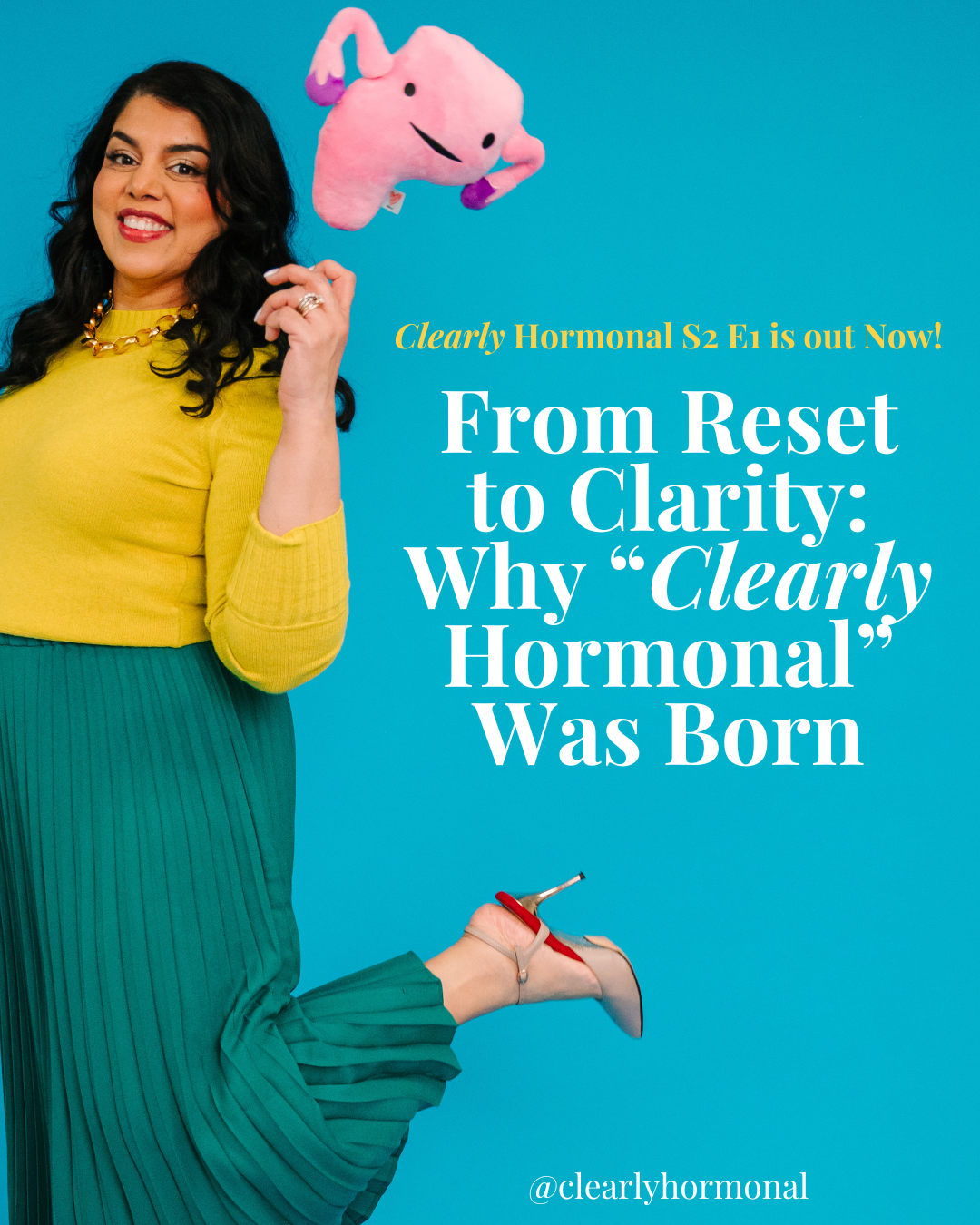
S2E1: From Reset to Clarity: Why “Clearly Hormonal” Was Born
Welcome to Clearly Hormonal
(formerly Reset Recharge)
S2 E1.
Do you ever feel like you’re not getting straight answers about your hormones, your cycle, or your health? You’re not alone. Women’s health has historically been under researched, undervalued, and under resourced, leaving many women stuck navigating symptoms without real clarity or support.
In this episode, Dr. Komal Patil-Sisodia (endocrinologist, internist, obesity medicine specialist, and Menopause Society certified practitioner introduces her newly rebranded podcast, Clearly Hormonal, and shares why she made the decision to move away from Reset Recharge.
Through a variety of personal and professional experiences in women’s healthcare, she has gained a deep understanding of how the gaps in research and education impact both patients and providers – and why so many women end up feeling dismissed, misdiagnosed, or misunderstood.
Dr. Patil-Sisodia breaks down the systemic issues that have shaped women’s healthcare, why confusion around reproductive and hormonal health is so common, and what needs to change.
Her mission with Clearly Hormonal is simple but powerful: to cut through the noise, identify the right questions, and empower women by providing them the clarity and knowledge they deserve.
From Reset to Clarity: Why Clearly Hormonal Was Born
By Dr. Komal Patil-Sisodia, MD | Eastside Menopause & Metabolism
Something has been sitting with me for a while.
I've been doing this work for 17 years. And the more time I spend with patients — really in the room with them, listening — the more I keep coming back to the same thing.
Women are trying to figure out their health. They're genuinely trying. They're Googling at midnight. They're bringing printed lab results to appointments. They're tracking symptoms in their notes app because they need someone to take them seriously. They are doing everything right.
And they're still confused.
Not because they're not smart. Not because the information isn't out there. But because no one has given them a clear framework to actually make sense of what's happening in their own bodies.
That's what this show is going to do.
Why I Almost Wasn't Here
If you followed me over from Reset, Recharge — thank you. Seriously. You showed up when this was just me, a microphone, and a lot of things I needed to get off my chest. That mattered more than you know. This rebrand is still me. Same doctor, same mission, same deep frustration with a medical system that keeps failing women. What has changed is that I've gotten clearer about what I'm trying to do, who I'm trying to reach, and what the show actually needs to be to get there. So let me tell you a little bit about where I'm coming from — and why this work is anything but abstract for me.
It Starts With My Mom
In 1998, I was a senior in high school. My mother was 42 years old and it took two years to diagnose her heart disease. Here's the context that makes that delay even more devastating: at that point, there were only about five years of meaningful cardiovascular research that actually included women. Five years. The data to recognize what heart disease looks like in a woman — how it presents differently, how it should be approached differently — was barely there. When the diagnosis finally came, stent technology was still new enough that open heart surgery was the only path forward. That surgery was the beginning of a long health decline for her. I think about what her life might look like today had there been more research, more advocacy, more urgency around women's health 25 years ago. That question is part of why I do this work.
And Then I Became the Patient
I struggled with PCOS when I was young, and getting that diagnosis was its own fight. At the time, it was looked at as purely a reproductive disorder — we now know it carries significant metabolic implications, including increased risk for insulin resistance, high cholesterol, high blood pressure, and heart disease. After the birth of my son, postpartum weight in the context of PCOS became its own challenge. And somewhere in the middle of all of that, I had to reckon with something I was not prepared for as a physician: my body was changing in ways I could not control through lifestyle alone. Knowing something clinically and living it are two completely different things. I had to dig deep and talk to myself the way I talk to my patients — first acknowledging that what was happening wasn't my fault. It wasn't a failure of discipline or knowledge or will. It was genetics. A hand of cards I'd been dealt that I didn't choose and couldn't change. Accepting that I needed medical help, as someone who has devoted her career to offering help to others, was way more complicated than I expected. The irony is not lost on me. But I've come to believe that difficulty isn't a character flaw. It's core to the human experience — especially the female experience. We are so conditioned to push through, to optimize, to try harder. Accepting our own biology as something outside of our control can feel like giving up. It's not giving up. It's one of the most honest things you can do for yourself. And then there was endometriosis. A condition I lived with for years before it was identified. I want to sit with that for a second — because I was a physician when this was happening. I had the training, the language, and I understood the system from the inside. And I still faced a delayed diagnosis. It took 10 years. After my hysterectomy, I remember the specific feeling of realizing what life without pain was supposed to feel like. I felt better three days after surgery than I had on any day of my period in the last decade. If I couldn't navigate the system as a doctor, I kept asking myself: what is it like for everyone else? That's when I knew that seeing patients in a clinic wasn't going to be enough.
The Four Gaps No One Is Naming Clearly Enough
1. Care is fragmented. Your gynecologist is managing your cycle. Your internist is managing your cholesterol. Your psychiatrist is adjusting your antidepressant. And the system isn't built for them to see the full picture together. Hormones are the connective tissue — they affect your metabolism, your mood, your sleep, your cardiovascular risk, your bone density, your brain. When each piece gets managed in isolation, the whole story gets missed.
2. The information women do get isn't actually useful. "Your labs are normal." Normal compared to what? Normal for a 45-year-old in perimenopause, or a 25-year-old? What does the number mean for how she feels? Normal is not a plan. And without a plan, women are just waiting.
3. There's a fundamental mismatch between what women are experiencing and what gets addressed. I can't tell you how many women have sat across from me describing symptoms they've had for years — fatigue that doesn't make sense, weight that doesn't respond to anything, brain fog, joint pain, sleep that has completely fallen apart — and when I ask what their previous doctor said, the answer is some version of: they said everything looked fine. You're not making it up. The symptoms are real. The gap is real.
4. This is not just a medical problem. It's a political one. The Women's Health Initiative — the 2002 study that upended hormone therapy overnight and sent an entire generation of women off their prescriptions — was later found to have been significantly misinterpreted. The same generation of women who fought for bodily autonomy and reproductive rights were then denied access to evidence-based hormonal care. And in 2022, the rights they fought for were stripped away. Women's health and women's rights have always been intertwined. The research gaps, the dismissed symptoms, the undertreated conditions — they don't happen in a vacuum. They happen in a culture that has historically treated women's bodies as secondary, as complicated, and as not worth the investment.
Why Clearly Hormonal
Both words are doing real work. Clearly is about precision. It's about cutting through the noise — and there is so much noise in women's health right now. Evidence over trend. Clinical reality over wellness marketing. Clarity, to me, is an act of respect. You can handle real information. You're going to get it here. Hormonal — I chose this word on purpose. Partly because hormonal has been used against women for a long time. It's been a dismissal. A punchline. She's just being hormonal. As if your hormones are an excuse or a flaw or something to be minimized. Here's what I know after 17 years: hormones are not a flaw. They are a system. They are why your energy, your metabolism, your cognition, your cardiovascular health, your mood — all of it — are connected. When that system is off, everything downstream is affected. That's not drama. That is physiology. So I'm putting it right in the name, because I am done treating it like something to tiptoe around.
What to Expect From This Show
Here's exactly what we're going to do together:
Hormones, clearly explained — no jargon without translation, ever.
Endocrinology beyond reproductive health — yes, perimenopause and menopause, but also thyroid, adrenal function, metabolic health, insulin resistance, and cardiovascular risk .
What to actually do — what to monitor, what questions to ask your doctor, what to push back on when something doesn't feel right Understanding is only the first step.
What I want for you is agency. The ability to walk into your next appointment knowing exactly what you need, knowing how to advocate for yourself, and knowing when to find someone else if you're not getting it. That is what Clearly Hormonal is for.
One More Thing
Outside of the podcast, I've been working on something in my practice that I've been teasing on social — a tool called the Midlife Health Compass™. Not just more content or more information, but a real framework. A structured way to look at the full picture of your hormonal health and actually know where you stand. More on that soon.
If this resonated with you — if you heard something in here that sounded like your experience — I want you to think of one woman in your life who needs to hear it. A friend who's been told her labs are fine when she knows something's off. A sister who's been brushed off.
Send it to her. This is how we change this.
Subscribe wherever you listen, and find me on TikTok and Instagram at @drpatilsisodia.
I'll see you on the next episode.
Dr. Komal Patil-Sisodia is a triple board-certified physician (Internal Medicine, Endocrinology, Obesity Medicine) and Menopause Society Certified Practitioner. She is the founder of Eastside Menopause & Metabolism and host of the Clearly Hormonal podcast.